
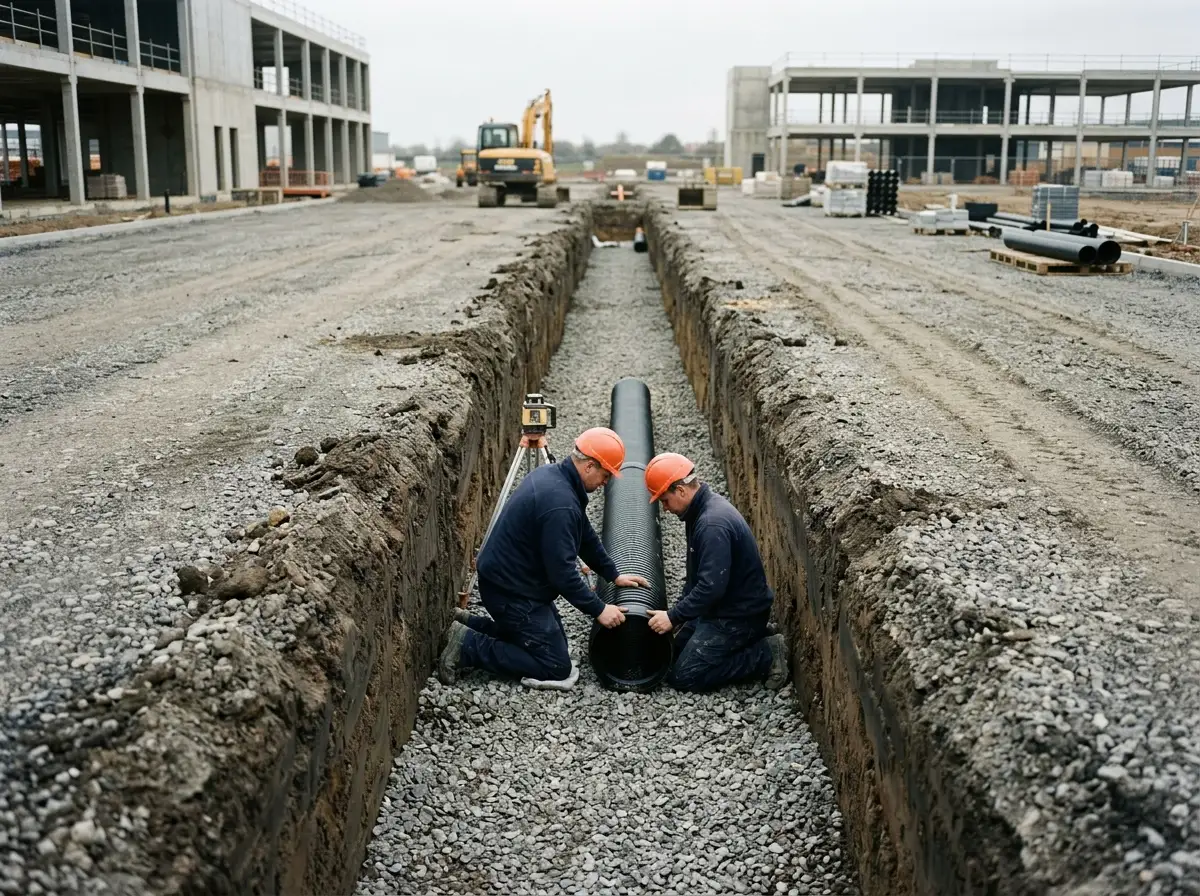
Drainage for a surface large enough to shed nearly everything that lands on it, where volume, grate loading and permitted discharge are all different questions than they are on a house.
Where this stops being a contracting job
Scale changes the arithmetic rather than the method. An acre of paving sheds roughly 27,000 gallons in a 1 inch storm, and almost none of it soaks in. That volume decides pipe size, basin count and where it can be sent, and a house-sized answer does not scale up to meet it.
Three things move this out of contracting and into engineering, and it is worth knowing which side you are on before you ask for a price. Discharge into a public storm system usually needs permission and a calculated flow. A detention or retention requirement needs a design, not a quote. And anything crossing a property line or an easement needs the paperwork settled first.
If none of those apply — a service yard draining to your own ground, a loading dock, a building edge — this is ordinary drainage at a larger size, and the pages on this site price it the same way. A small business in a converted house has a house’s problem, and the other pages here are more honest about it.
The jobs this covers, and what each one costs to get wrong
Commercial & Industrial Drainage
Drainage sized for a paved site rather than a yard. Parking areas, loading docks, service yards and building edges, where water arrives as sheet flow off acres of hard surface. It applies when the surface is large and sheds nearly all of what lands on it. Volume, grate loading, and where a site may discharge are different questions on a commercial lot. A house-sized answer does not scale up.
What moves the price. What grate class the vehicles crossing it need. How far it is to a discharge point the site may use. And whether the work has to fit around trading hours. Phasing to keep a lot open is often the biggest line.
When commercial drainage is the wrong answer. A small business in a converted house has a house’s drainage problem. The other pages price that more honestly. Anything touching a public storm system or a detention rule is engineering before it is contracting. That needs a design in hand first.
Excavation Services
Machine and hand digging for drainage work — trenching, footing exposure, backfill and compaction. It is the underlying trade rather than a product. It applies when access, spoil handling or compaction is the hard part of the job rather than the pipe.
What moves the price. Access, more than volume. A machine that can reach the dig works in hours. The same trench by hand takes days. Then spoil: soil that can stay on site is cheap, soil that has to be carted off is not.
When excavation is the wrong answer. If the hard part is the pipe and not the hole, this is the wrong line to price. A short run across open lawn is a drainage job. Pricing it as excavation pays for the machine twice.
Get an estimate in Syracuse
None of this can be priced from a description. Three things decide it. What the ground does with water. How much fall the site has. Where the water may go at the end. All three are facts about an address, and none of them show up in a photograph. Send the address and what you are seeing. Someone who does this work in Syracuse takes it from there. If it turns out to be a cheaper job than the one you came here for, that is worth hearing before anyone digs.
Syracuse Utah French Drain drainage services.
Read what a Syracuse drainage job costs before calling anyone, and check the Syracuse Utah French Drain service area to see whether your street is covered.
Back to Syracuse Utah French Drain.
The ground under Syracuse
This is the storm a system is normally sized against
A ten-year storm drops 2.08 inches in a day
Design storm depths are what an engineer sizes pipe and detention against. Published by the National Weather Service for this location with a stated confidence range, which is why they can be checked rather than taken on trust.
NOAA Atlas 14 Volume 1 Version 5, Precipitation Frequency Data Server
The rare storm is what overflow provision is for
A hundred-year storm drops 2.94 inches in a day
A hundred-year storm has a one percent chance of being matched or exceeded in any given year. It is not the sizing case for most private work, but it is the case that decides where water goes when the primary system is full.
NOAA Atlas 14 Volume 1 Version 5, Precipitation Frequency Data Server
Questions people actually ask
How much water does a paved site shed?
Close to all of it. Reckon on 27,000 gallons per acre in a 1 inch storm against roughly 3,000 from the same area of lawn. That factor of 9 is why a commercial system is sized by calculation rather than by eye.
What grate class does a loading dock need?
Class D or E where loaded trucks cross, set in a concrete surround rather than bedded. A Class B grate under a delivery vehicle fails inside 1 season, and replacing it means breaking out the surround as well.
Can the work happen without closing the site?
Usually, and phasing is often the largest single line in the price. Expect the job to take 2 to 3 times as long done in sections around trading hours as it would with the lot closed. That trade is worth pricing both ways before deciding.
When does this need an engineer?
Whenever the design discharges to a public storm system, requires detention, or crosses an easement. Those need a calculated flow and a drawing before a contractor can price anything, and 1 site meeting early is cheaper than a redesign.
Is excavation priced by volume?
By access first, volume second. A machine that reaches the dig clears in 1 day what takes 3 by hand through a gate under 3 feet wide. Then spoil: soil that stays on site is cheap, soil carted off is priced per load and often exceeds the digging.
Trusted across Syracuse, Utah and Davis County
What this site is good for
-
Residential and commercial
A house with a wet basement and a site with standing water on a hardstanding are different jobs at different scales. Both are covered, and the pages say which is which.
-
Free, and nothing attached
Working out which job you actually have costs nothing and commits you to nothing. There is no fee to you at any point, because this site is paid by the contractor and not by you.
-
Your details are not for sale
An address sent here goes to a drainage contractor working in the area. It is never sold, and never passed to a second firm.
-
Permits named, not glossed
The pages name the authority that issues the permit for this work and the inspection that goes with it, so you can ask to see one before the first cut.
-
Every figure sourced and dated
Soil, rainfall and housing figures each name where they came from and when they were retrieved. Where a published estimate carries a margin of error, the margin is shown too.
-
One town, covered properly
This site is about one place and the towns within a short drive of it. It is not a national directory with a city name dropped into a template.
-
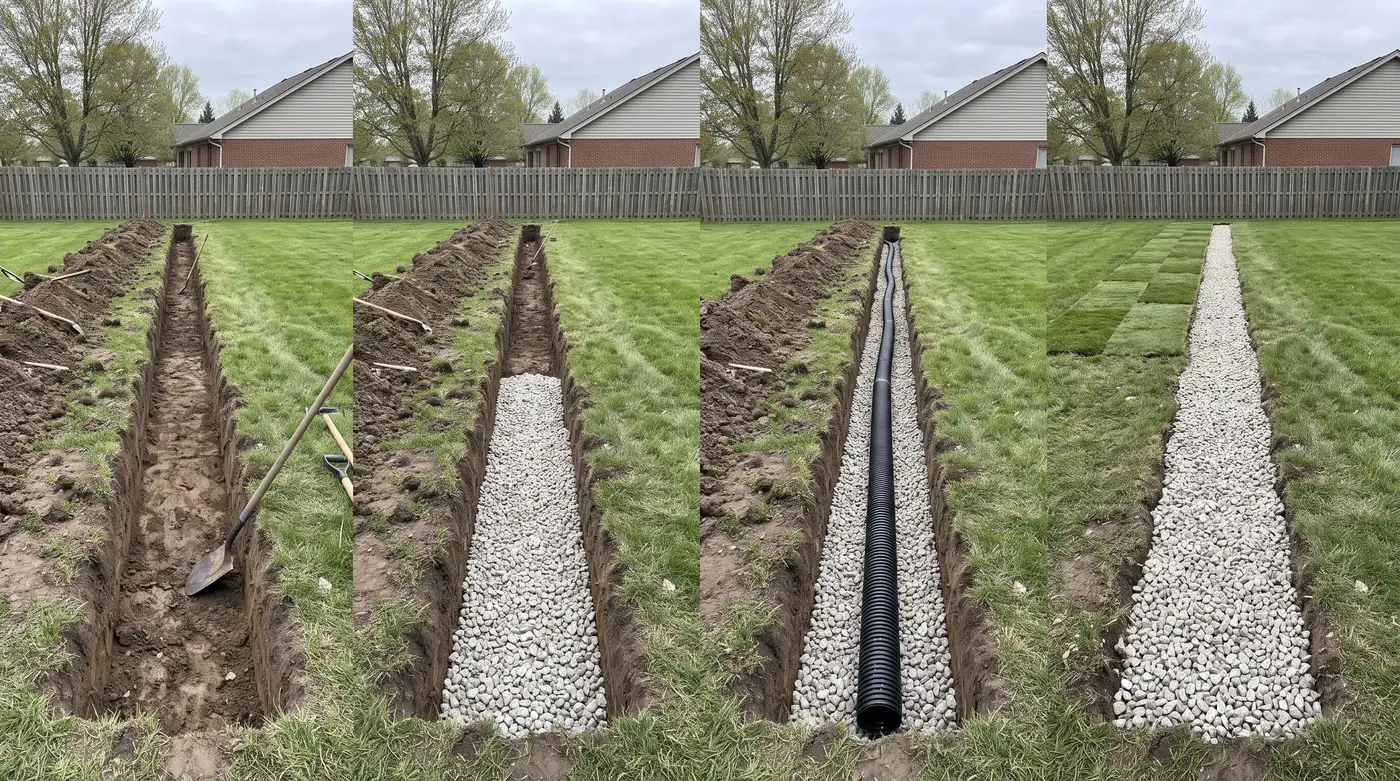
One run at four stages. The stone is the drain; the pipe is only how the water it collects gets out. -
Water standing at grade. Ground that sheds rather than takes is what puts it there. -
Pipe seated on the stone bed. Trench walls cut clean, so no soil falls back into the stone.

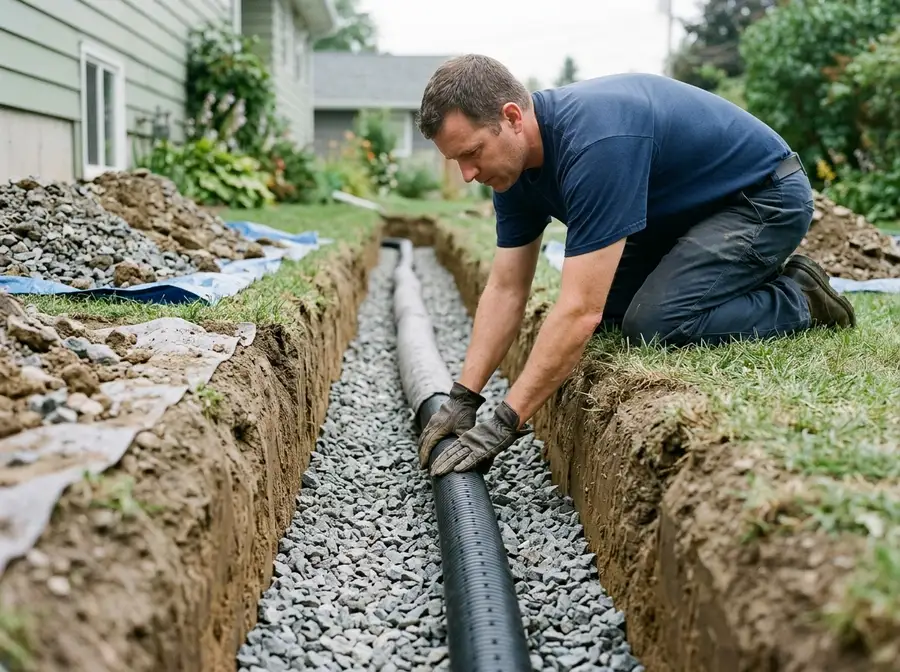
Ground that is saturated has nowhere to put the next storm, and water sitting against a wall keeps working on it.
What happens after you send an address
-
The address first, and only then who you are
The first screen asks for the property address and checks that a contractor covers it. Only if one does does it ask for a name, a phone number and an email — there is no point taking your details to tell you nobody serves your street.
-
Your details are not for sale
It goes to a drainage contractor working in Syracuse. The details are never sold, and never passed to a second firm.
-
No cost, and nothing attached
There is no fee for sending an address and no obligation that follows from it. Deciding the work is the wrong work is a perfectly good outcome.
-
Who does the work
An independent drainage contractor, not the publisher of this site. Who runs this site, and where every figure on it comes from, is set out on the about page.