
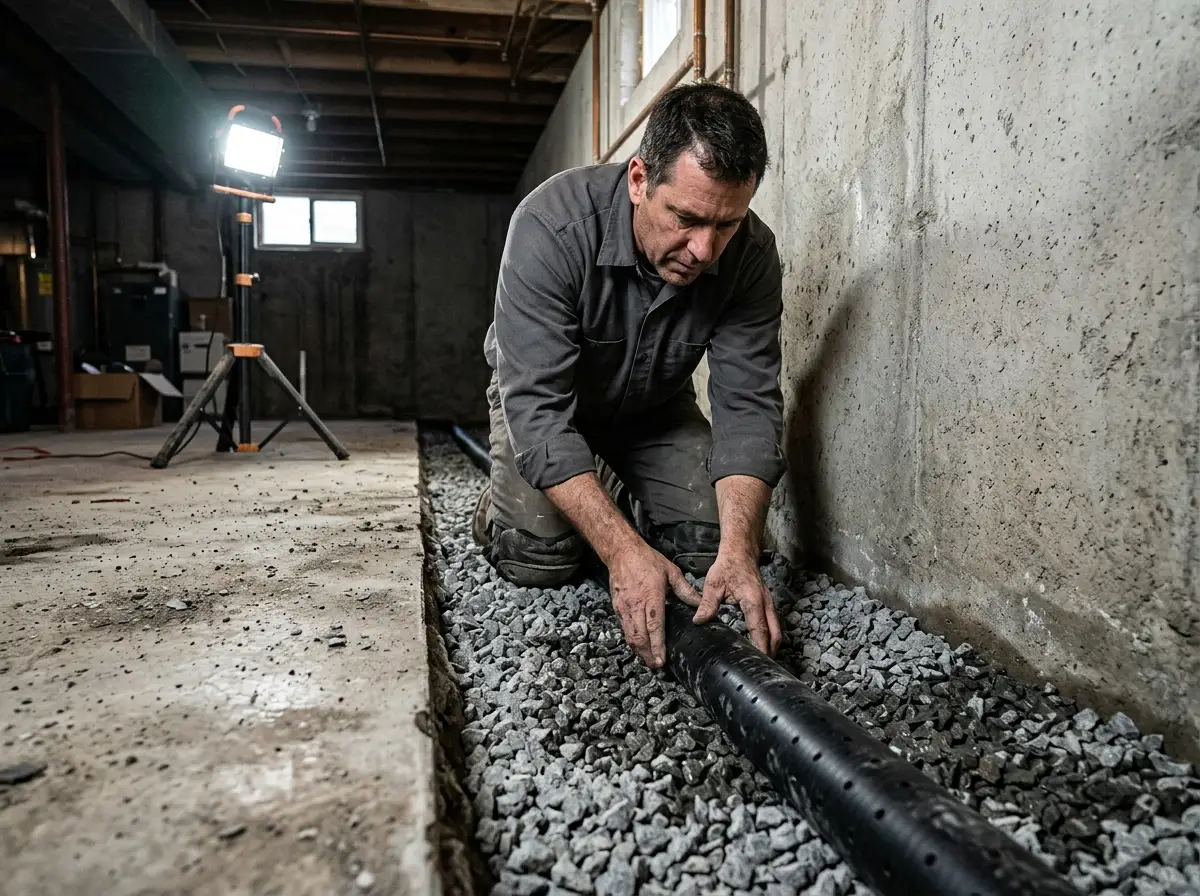
An interior French drain breaks the slab edge along the basement wall, sets a perforated pipe beside the footing, and sends what it catches to a sump pump that lifts it outside.
Is the inside the right side to work from?
Work from the inside when the outside is not available. A finished patio, a drive against the house, a shared wall, or a mature tree in the way all remove the exterior option, and an interior drain is what is left. It is also the answer when water is already arriving and the dig season has closed.
Work from the inside when the water is coming up rather than in. Damp across a whole wall, or water appearing through the slab, is the water table rather than a fault outside one spot. An interior drain and a pump relieve that; sealing a wall does not.
Do not start here when the ground outside still falls toward the house, or a downspout ends within 6 feet of the wall where the water shows up. Those are surface problems and they are the cheapest thing on this page. An interior drain installed around either of them moves the water without removing the cause.
Both of those choices have a page of their own: Interior vs Exterior French Drain in Syracuse, UT and French Drain vs Sump Pump in Syracuse, UT.
The jobs this covers, and what each one costs to get wrong
Basement Waterproofing
Sealing the inside of a foundation wall and draining it, usually with a perimeter drain that feeds a sump. It is the answer when water is already inside and the outside cannot be dug — a finished patio, a shared wall, or a drive against the house.
What moves the price. How much wall gets treated. Whether the floor has to be broken to reach the footing. And what has to come out and go back — a finished basement adds that to every foot, and it is usually the bigger half.
When basement waterproofing is the wrong answer. If the outside can still be dug, a footing drain treats the cause and this treats the sign. Water at one wall with a downspout beside it is a downspout problem. Sealing the inside leaves the water where it was.
Sump Pump Installation & Repair
A basin set below the slab, a pump, a check valve and a discharge line taken well clear of the foundation. It is the answer where there is nowhere downhill to send water by gravity. A flat lot removes the option a French drain depends on.
What moves the price. Where the water may be sent, and how far the line runs to get there. Cutting a slab for a new basin costs more than dropping a pump into one that exists. A flat lot needs that line carried further than most people expect.
When a sump pump is the wrong answer. If the lot falls to somewhere lower, a gravity drain does the same work. Nothing to fail, and nothing to power. A pump is what is left when there is nowhere lower to send water.
Crawl Space Drainage
A perimeter drain and sump under a crawl space, usually with a vapor barrier over the ground. It applies when the ground under the floor is wet. The space is the foundation’s inside face even though nobody stands in it.
What moves the price. Headroom, and how much of the work is done lying down. Getting spoil out and stone in through a small hatch is the other multiplier. A vapor barrier is priced by floor area, not by perimeter.
When crawl space drainage is the wrong answer. A crawl space that is damp rather than wet is often a venting and grading problem at the surface. Trenching under a floor to deal with water from the flower bed outside is the long way round.
Get an estimate in Syracuse
None of this can be priced from a description. Three things decide it. What the ground does with water. How much fall the site has. Where the water may go at the end. All three are facts about an address, and none of them show up in a photograph. Send the address and what you are seeing. Someone who does this work in Syracuse takes it from there. If it turns out to be a cheaper job than the one you came here for, that is worth hearing before anyone digs.
Syracuse Utah French Drain drainage services.
Read what a Syracuse drainage job costs before calling anyone, and check the Syracuse Utah French Drain service area to see whether your street is covered.
Back to Syracuse Utah French Drain.
The ground under Syracuse
For part of the year the water outside your wall is higher than your floor
The shallowest mapped water table sits 3.1 inches down
Seasonal high water table is the depth the ground water rises to in a normal wet spring. Where it comes up above a footing, water reaches a basement wall under pressure rather than by running down it, and that changes which repair works.
USDA NRCS Soil Survey Geographic Database (SSURGO), via Soil Data Access
A pump is sized against the storm that arrives most often, not the worst one
A two-year storm drops 1.53 inches in a day
This is the daily rainfall expected about every other year, which is the load an interior drain and its pump handle repeatedly rather than once. A basin that empties fast enough for the design event and cycles constantly at this depth is the wrong pump for the house, and it is the failure seen most.
NOAA Atlas 14 Volume 1 Version 5, Precipitation Frequency Data Server
Questions people actually ask
How much of the floor has to come up?
A strip 12 to 18 inches wide along the wall being drained. The concrete is cut, not broken out whole, and it goes back over the new stone. On a perimeter run the cut follows the wall rather than crossing the floor, so furniture in the middle of the room is usually not in the way.
How long does an interior drain take?
Usually 2 to 3 days for a perimeter run. Digging the same length outside takes 3 to 5, and longer once a patio, drive or grown planting has to come off and go back. The pipe is a small part of either number.
Where does the water go once it is inside?
Into a basin set below the slab, then out through a discharge line taken well clear of the foundation — 10 feet is a working minimum, further on flat ground. A line that ends beside the wall returns the water to the drain that just removed it.
Does an interior drain stop the wall getting wet?
No, and it is not meant to. It relieves water at the footing, 7 to 8 feet down on a full basement, so the water has an easier path than through the wall. A wall that is wet because the ground outside falls toward it stays wet until the grade is fixed.
Can this be done in a finished basement?
Yes, and the finish is usually the bigger half of the cost. Framing, drywall and flooring within about 2 feet of the wall come out and go back, priced by the foot the same as the drain. Ask for those two numbers separately before comparing quotes.
Trusted across Syracuse, Utah and Davis County
What this site is good for
-
Residential and commercial
A house with a wet basement and a site with standing water on a hardstanding are different jobs at different scales. Both are covered, and the pages say which is which.
-
Free, and nothing attached
Working out which job you actually have costs nothing and commits you to nothing. There is no fee to you at any point, because this site is paid by the contractor and not by you.
-
Your details are not for sale
An address sent here goes to a drainage contractor working in the area. It is never sold, and never passed to a second firm.
-
Permits named, not glossed
The pages name the authority that issues the permit for this work and the inspection that goes with it, so you can ask to see one before the first cut.
-
Every figure sourced and dated
Soil, rainfall and housing figures each name where they came from and when they were retrieved. Where a published estimate carries a margin of error, the margin is shown too.
-
One town, covered properly
This site is about one place and the towns within a short drive of it. It is not a national directory with a city name dropped into a template.
-
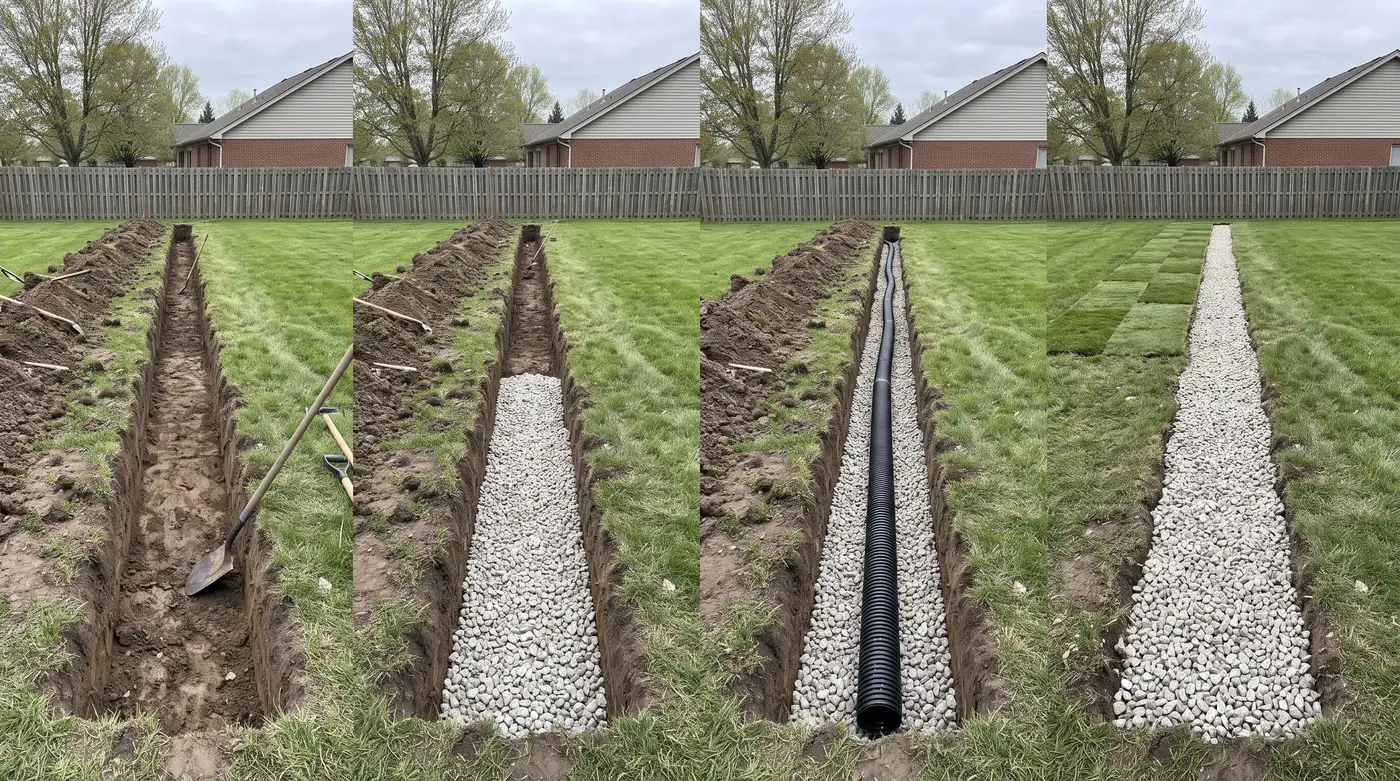
One run at four stages. The stone is the drain; the pipe is only how the water it collects gets out. -
Water standing at grade. Ground that sheds rather than takes is what puts it there. -
Pipe seated on the stone bed. Trench walls cut clean, so no soil falls back into the stone.

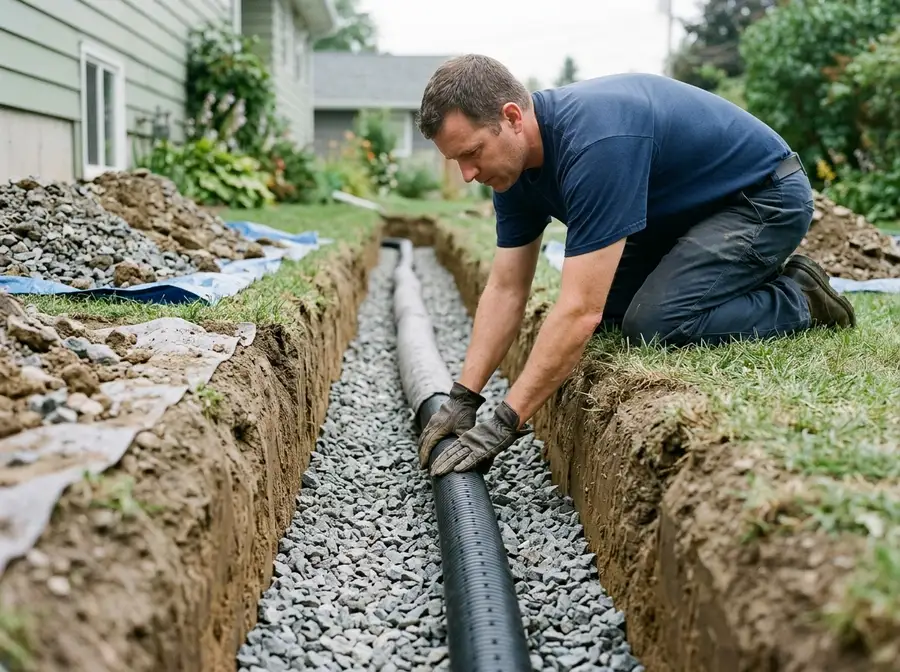
Ground that is saturated has nowhere to put the next storm, and water sitting against a wall keeps working on it.
What happens after you send an address
-
The address first, and only then who you are
The first screen asks for the property address and checks that a contractor covers it. Only if one does does it ask for a name, a phone number and an email — there is no point taking your details to tell you nobody serves your street.
-
Your details are not for sale
It goes to a drainage contractor working in Syracuse. The details are never sold, and never passed to a second firm.
-
No cost, and nothing attached
There is no fee for sending an address and no obligation that follows from it. Deciding the work is the wrong work is a perfectly good outcome.
-
Who does the work
An independent drainage contractor, not the publisher of this site. Who runs this site, and where every figure on it comes from, is set out on the about page.