
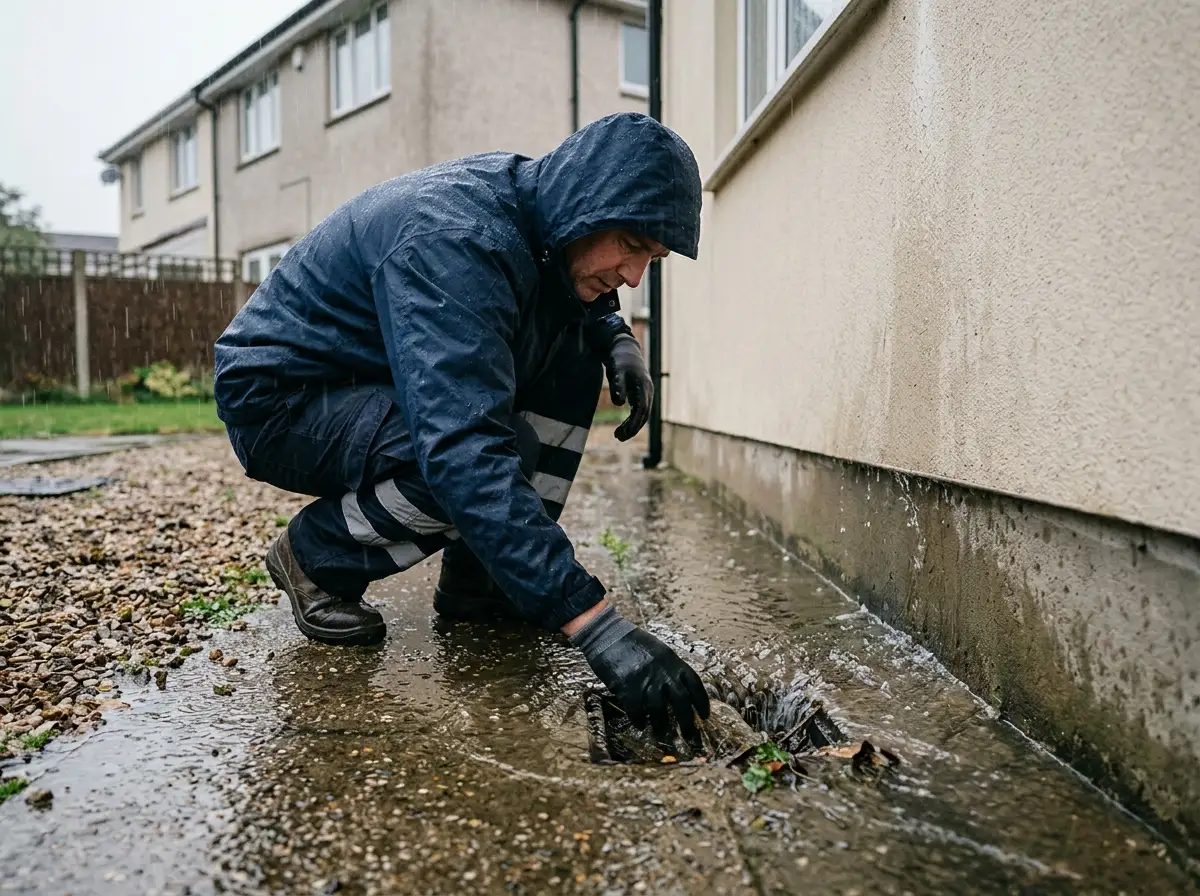
Getting standing water away from a structure while it is still happening, then finding why it arrived. Those are two different jobs.
What to do before anyone arrives
Kill the power to the affected area at the board before standing in water. Do it from a dry position. Water and a live socket at floor level is the part of this that hurts people, and it takes 30 seconds.
Then find where it is coming in and go outside, because almost every basement flood has a surface cause you can see and reach. Look at the downspouts first. A blocked one puts the whole roof against the wall, and clearing it or dragging the outlet 6 feet away can slow the flow while you wait. Look for a low point beside the house, a window well filling, or a drive channelling toward the door.
Move what you can lift and photograph what you cannot, before anything is pumped or dried. A claim is far easier with pictures taken while the water was in the room. The permanent fix is a different visit and a different price, and it is worth pricing in the dry — a job scoped in a storm is scoped by the storm.
That choice has a page of its own: French Drain vs Sump Pump in Syracuse, UT.
The jobs this covers, and what each one costs to get wrong
Emergency Drainage Service
Getting standing water away from a structure while it is still happening, then finding why it arrived. It applies during the event. The temporary measure and the permanent fix are different jobs, and treating them as one is how a repeat happens.
What moves the price. The hour it is called at, and how much water there is to move. Getting the building out of danger is one scope. Stopping it happening again is another. Priced as one job, the second visit is the result.
When emergency drainage service is the wrong answer. Once the water has gone and the ground has dried, this is the wrong page. The lasting fix is a graded surface, a drain, or a pump. All three are priced better in the dry than in a storm.
Get an estimate in Syracuse
None of this can be priced from a description. Three things decide it. What the ground does with water. How much fall the site has. Where the water may go at the end. All three are facts about an address, and none of them show up in a photograph. Send the address and what you are seeing. Someone who does this work in Syracuse takes it from there. If it turns out to be a cheaper job than the one you came here for, that is worth hearing before anyone digs.
Syracuse Utah French Drain drainage services.
Read what a Syracuse drainage job costs before calling anyone, and check the Syracuse Utah French Drain service area to see whether your street is covered.
Back to Syracuse Utah French Drain.
The ground under Syracuse
The storm that floods most yards here is not a rare one
A two-year storm drops 1.53 inches in a day
A two-year storm is the size of storm you would expect roughly every other year. Published by the National Weather Service as a design depth for this location, with a stated confidence range. If that much rain puts water where it should not be, the problem is the ground and the grade, not the weather.
NOAA Atlas 14 Volume 1 Version 5, Precipitation Frequency Data Server
The rarer storm is the one that decides whether a system copes
A ten-year storm drops 2.08 inches in a day
Set this against the two-year depth above it. The gap between the storm you get most years and the one you get once a decade is what extra capacity buys, and how wide that gap is here is the thing worth checking before anyone sizes a system for you.
NOAA Atlas 14 Volume 1 Version 5, Precipitation Frequency Data Server
Questions people actually ask
What should I do first?
Cut the power to the affected area from a dry position, then check the downspouts outside. Those 2 steps take under 5 minutes and they are the only ones that change the outcome before anyone arrives.
Is this an emergency or can it wait?
Water rising against a structure, entering a living space, or standing within 3 feet of an electrical panel is an emergency. Water in a yard that is falling within 24 hours of the rain stopping is not, and it is priced far better in the dry.
Will pumping it out fix the problem?
No. Pumping removes the water and changes nothing about why it arrived. Expect 2 visits: one to get the building out of danger, one to price the permanent fix once the ground has dried. Treating them as 1 job is how a repeat happens.
How long before the ground is dry enough to work?
Usually 3 to 7 days after the rain stops, longer in clay. Excavating saturated ground damages its structure and the trench walls will not hold, so the permanent work waits whatever the urgency.
Does insurance cover this?
It depends on the policy and on the cause, and that is decided by evidence rather than by argument. Photograph everything while the water is present and keep receipts for anything spent in the first 48 hours. Groundwater and surface flooding are commonly excluded where a burst pipe is not.
Trusted across Syracuse, Utah and Davis County
What this site is good for
-
Residential and commercial
A house with a wet basement and a site with standing water on a hardstanding are different jobs at different scales. Both are covered, and the pages say which is which.
-
Free, and nothing attached
Working out which job you actually have costs nothing and commits you to nothing. There is no fee to you at any point, because this site is paid by the contractor and not by you.
-
Your details are not for sale
An address sent here goes to a drainage contractor working in the area. It is never sold, and never passed to a second firm.
-
Permits named, not glossed
The pages name the authority that issues the permit for this work and the inspection that goes with it, so you can ask to see one before the first cut.
-
Every figure sourced and dated
Soil, rainfall and housing figures each name where they came from and when they were retrieved. Where a published estimate carries a margin of error, the margin is shown too.
-
One town, covered properly
This site is about one place and the towns within a short drive of it. It is not a national directory with a city name dropped into a template.
-
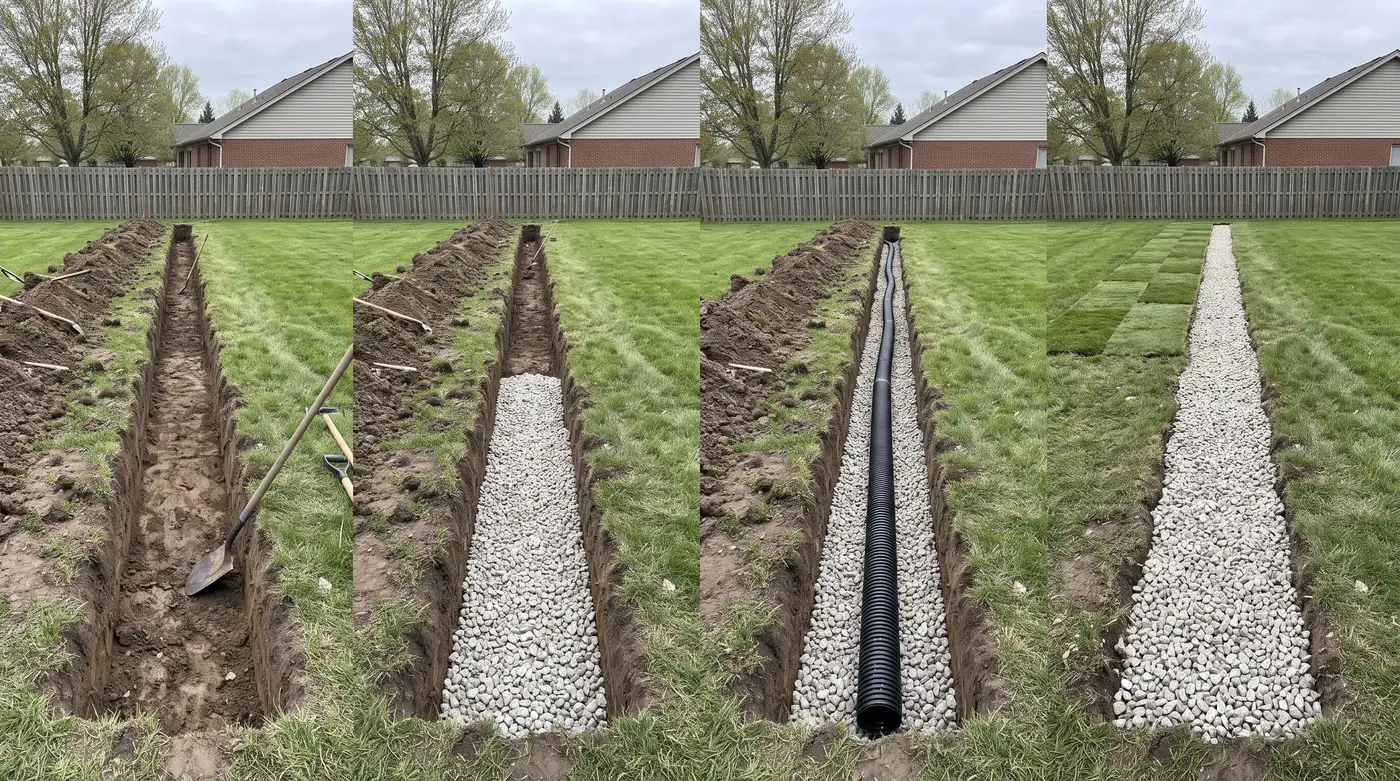
One run at four stages. The stone is the drain; the pipe is only how the water it collects gets out. -
Water standing at grade. Ground that sheds rather than takes is what puts it there. -
Pipe seated on the stone bed. Trench walls cut clean, so no soil falls back into the stone.

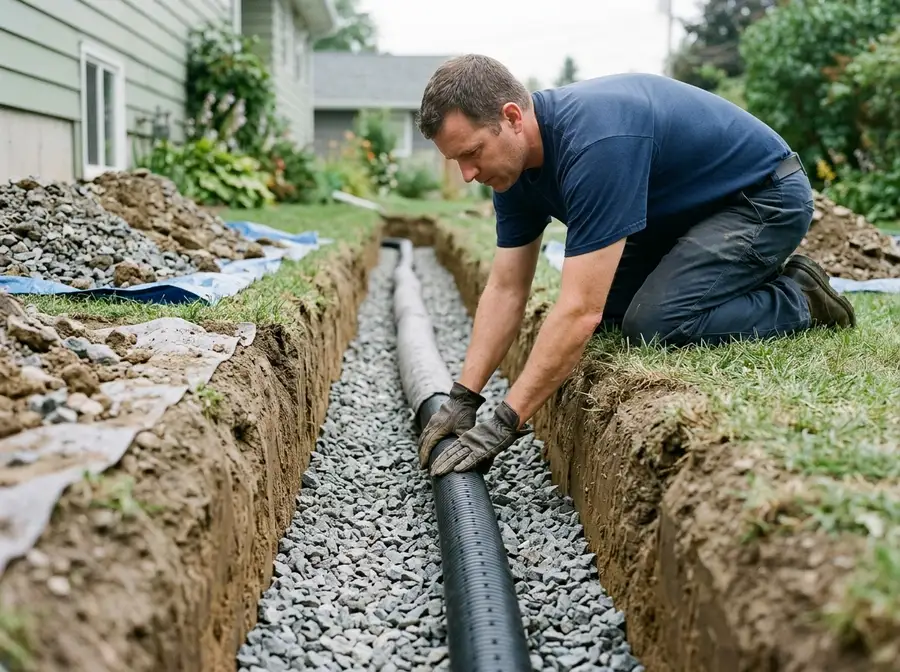
Ground that is saturated has nowhere to put the next storm, and water sitting against a wall keeps working on it.
What happens after you send an address
-
The address first, and only then who you are
The first screen asks for the property address and checks that a contractor covers it. Only if one does does it ask for a name, a phone number and an email — there is no point taking your details to tell you nobody serves your street.
-
Your details are not for sale
It goes to a drainage contractor working in Syracuse. The details are never sold, and never passed to a second firm.
-
No cost, and nothing attached
There is no fee for sending an address and no obligation that follows from it. Deciding the work is the wrong work is a perfectly good outcome.
-
Who does the work
An independent drainage contractor, not the publisher of this site. Who runs this site, and where every figure on it comes from, is set out on the about page.