
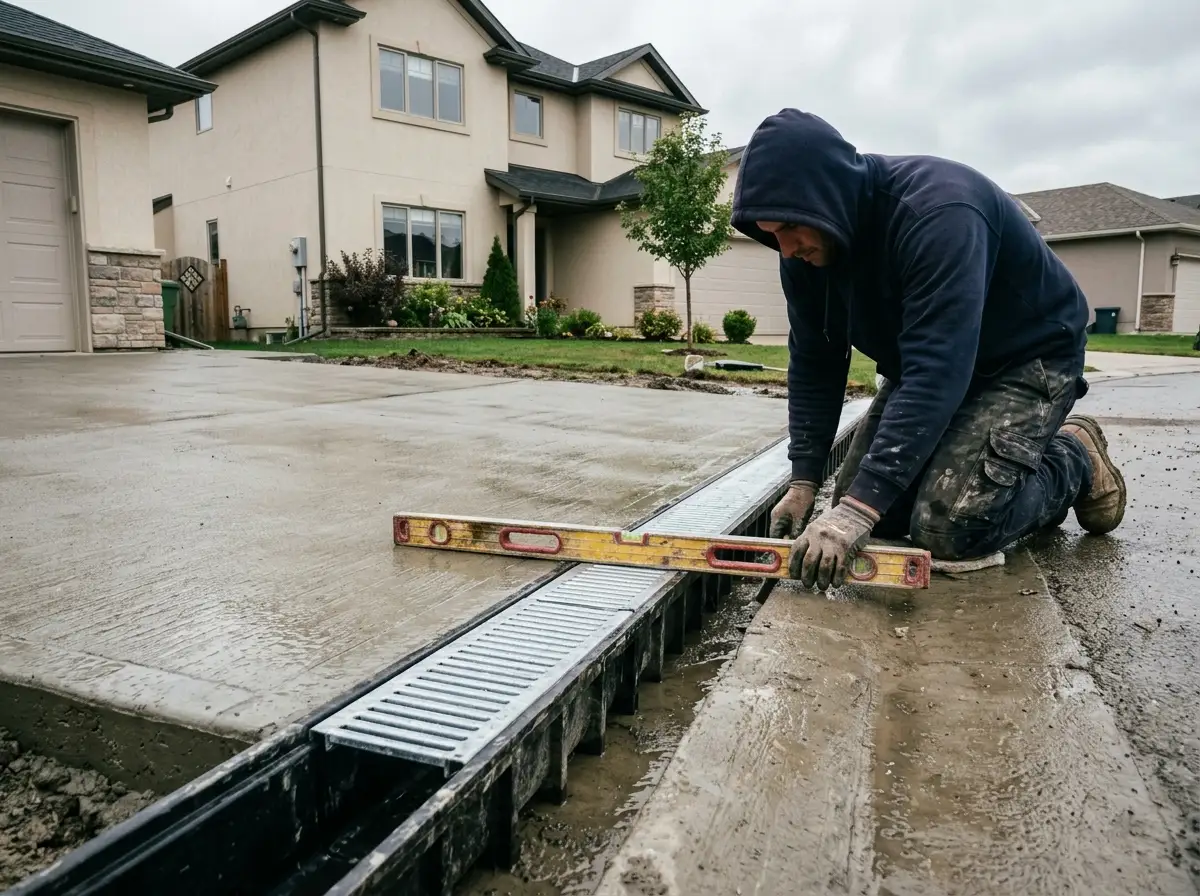
Water reaching a garage door is either sheet flow running down the paving, or roof water that was put on the paving by a downspout.
Roof water or slab water? Stand outside in real rain
This one is settled by watching, not by measuring, and it is worth the 10 minutes. Go out during actual rain and look at where the water crossing the slab starts. If it is arriving from a downspout, or from a stripe that leads back to one, this is a downspout job and a buried line takes it away for a fraction of a channel drain.
If the water is arriving as a sheet off the whole surface, look uphill of the paving. A drive that falls toward the building collects everything landing on it plus whatever runs off the ground beside it. That is what a trench drain across the slab is for, and there is no cheaper version.
Check one more thing before cutting concrete: where the water is allowed to go once caught. A channel drain with nowhere to discharge is a trough. On a flat lot that discharge point is often the hardest part of the job and it should be found before the saw arrives, not after.
The jobs this covers, and what each one costs to get wrong
Driveway Trench Drain
A channel across a slab with a grate along its length, taking sheet flow before it reaches a garage or a door. It is the answer where water runs across paving rather than through soil. A round basin cannot catch a sheet moving down a drive.
What moves the price. How wide the slab is, what grate class the traffic needs, and whether the channel is cast into new concrete or cut into old. Cutting into sound concrete is most of the cost.
When a driveway trench drain is the wrong answer. If the water at the garage came off the roof, the downspouts are the fix. A channel across the drive catches only part of it. Watch where it runs in real rain before cutting anything.
Downspout Drain Extension
Burying a solid line from the downspout to a discharge point clear of the foundation. It is the first thing to check and the cheapest thing to fix. A downspout should discharge at least 6 feet from the wall.
What moves the price. How far the line runs to clear the building, and what it crosses. Straight across open lawn is the cheapest work here. Under a drive, or through the roots of a big tree, is not.
When downspout drain extension is the wrong answer. Nothing, if the downspout already ends well clear of the wall and the ground falls away. Moving an outlet that is already in the right place changes where it sits, not what happens.
Get an estimate in Syracuse
None of this can be priced from a description. Three things decide it. What the ground does with water. How much fall the site has. Where the water may go at the end. All three are facts about an address, and none of them show up in a photograph. Send the address and what you are seeing. Someone who does this work in Syracuse takes it from there. If it turns out to be a cheaper job than the one you came here for, that is worth hearing before anyone digs.
Syracuse Utah French Drain drainage services.
Read what a Syracuse drainage job costs before calling anyone, and check the Syracuse Utah French Drain service area to see whether your street is covered.
Back to Syracuse Utah French Drain.
The ground under Syracuse
Runoff off a slab has nowhere to soak away at the bottom of the drive
The slowest mapped ground takes water at 0.13 inches an hour
A driveway sheds nearly everything that lands on it. Where it discharges onto slow ground, the water has to be carried away rather than absorbed, which is what a channel drain and a proper outfall are for.
USDA NRCS Soil Survey Geographic Database (SSURGO), via Soil Data Access
Some ground in this city is built to hold water, not carry it away
The wettest mapped soil here is 100% susceptible to ponding
This is a share of the soil map unit, not a rate per year. USDA's figure says how much of that ground is a closed low spot where water is expected to stand, not how often it happens. This is the highest share among the largest soils mapped here — the higher it runs, the more of that ground is built to hold water rather than shed it.
USDA NRCS Soil Survey Geographic Database (SSURGO), via Soil Data Access
Questions people actually ask
What grate class does a driveway need?
A residential car needs Class A or B. Anything a delivery truck crosses needs Class C or higher, and the frame has to be set in concrete rather than bedded. Getting this wrong is a grate that cracks inside 2 winters.
Can a trench drain be cut into an existing slab?
Yes, and the cutting is most of the cost. Expect a saw cut, breakout, and a repour either side of the channel — usually a 2 to 3 day job on a single drive against 1 day when the channel is cast into new concrete.
How far should a buried downspout line run?
Far enough to clear the building and reach ground that falls away, which on most lots is 10 to 20 feet. It needs the same 1 percent fall as any other line, and it should be solid pipe rather than perforated, because the point is to carry water past the foundation and not to release it there.
Will a channel drain freeze?
It can hold ice, which is why it is laid to fall and discharged to daylight rather than to a soakaway. A line with 1 inch of fall every 8 feet drains itself between storms and has nothing standing in it to freeze.
Do I need a permit to cut a driveway?
For work behind the property line, usually not. Anything touching the apron or the public right of way generally does, and that is a separate application from the drainage work. Ask before the saw cut, not after — the inspection window is typically 1 visit and it is easier to schedule up front.
Trusted across Syracuse, Utah and Davis County
What this site is good for
-
Residential and commercial
A house with a wet basement and a site with standing water on a hardstanding are different jobs at different scales. Both are covered, and the pages say which is which.
-
Free, and nothing attached
Working out which job you actually have costs nothing and commits you to nothing. There is no fee to you at any point, because this site is paid by the contractor and not by you.
-
Your details are not for sale
An address sent here goes to a drainage contractor working in the area. It is never sold, and never passed to a second firm.
-
Permits named, not glossed
The pages name the authority that issues the permit for this work and the inspection that goes with it, so you can ask to see one before the first cut.
-
Every figure sourced and dated
Soil, rainfall and housing figures each name where they came from and when they were retrieved. Where a published estimate carries a margin of error, the margin is shown too.
-
One town, covered properly
This site is about one place and the towns within a short drive of it. It is not a national directory with a city name dropped into a template.
-
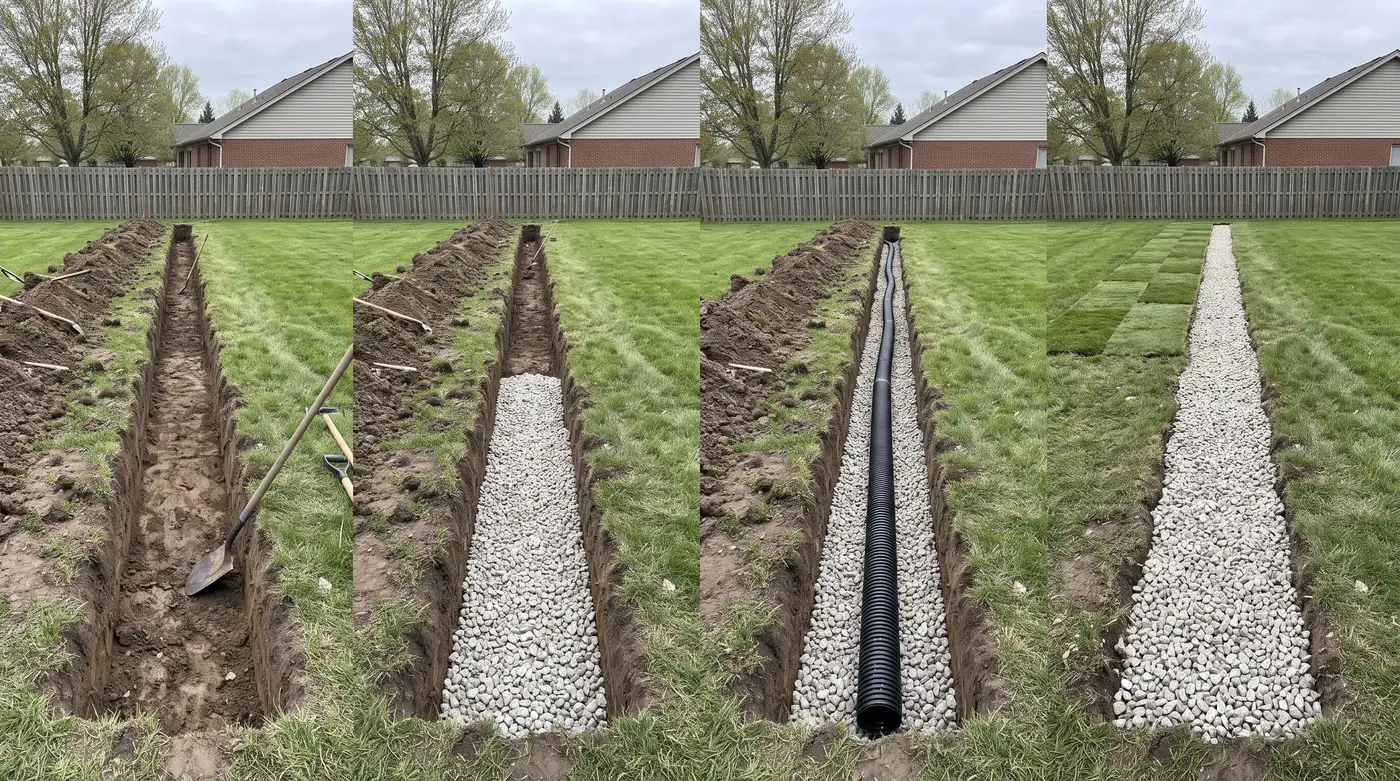
One run at four stages. The stone is the drain; the pipe is only how the water it collects gets out. -
Water standing at grade. Ground that sheds rather than takes is what puts it there. -
Pipe seated on the stone bed. Trench walls cut clean, so no soil falls back into the stone.

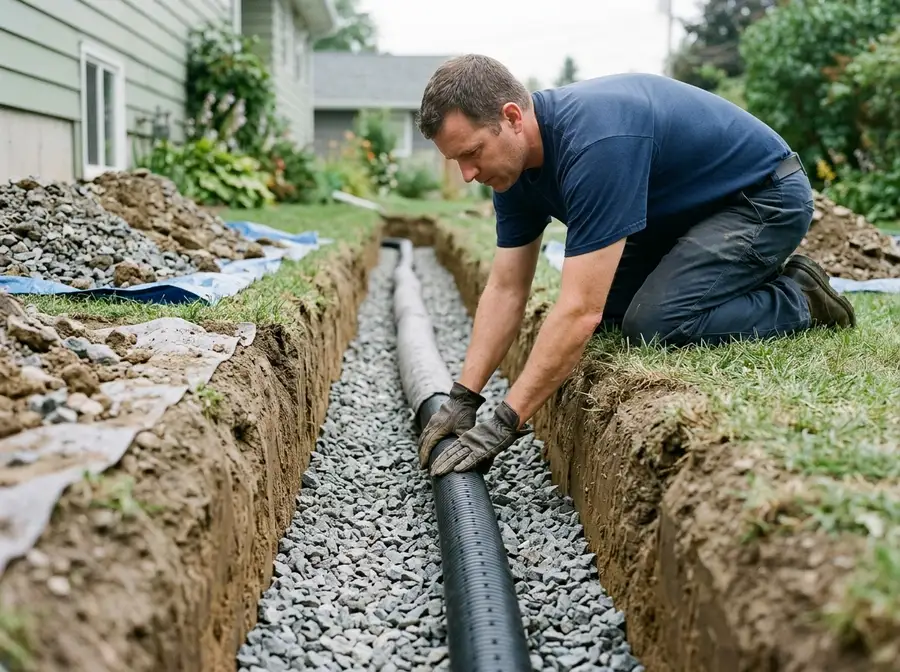
Ground that is saturated has nowhere to put the next storm, and water sitting against a wall keeps working on it.
What happens after you send an address
-
The address first, and only then who you are
The first screen asks for the property address and checks that a contractor covers it. Only if one does does it ask for a name, a phone number and an email — there is no point taking your details to tell you nobody serves your street.
-
Your details are not for sale
It goes to a drainage contractor working in Syracuse. The details are never sold, and never passed to a second firm.
-
No cost, and nothing attached
There is no fee for sending an address and no obligation that follows from it. Deciding the work is the wrong work is a perfectly good outcome.
-
Who does the work
An independent drainage contractor, not the publisher of this site. Who runs this site, and where every figure on it comes from, is set out on the about page.