
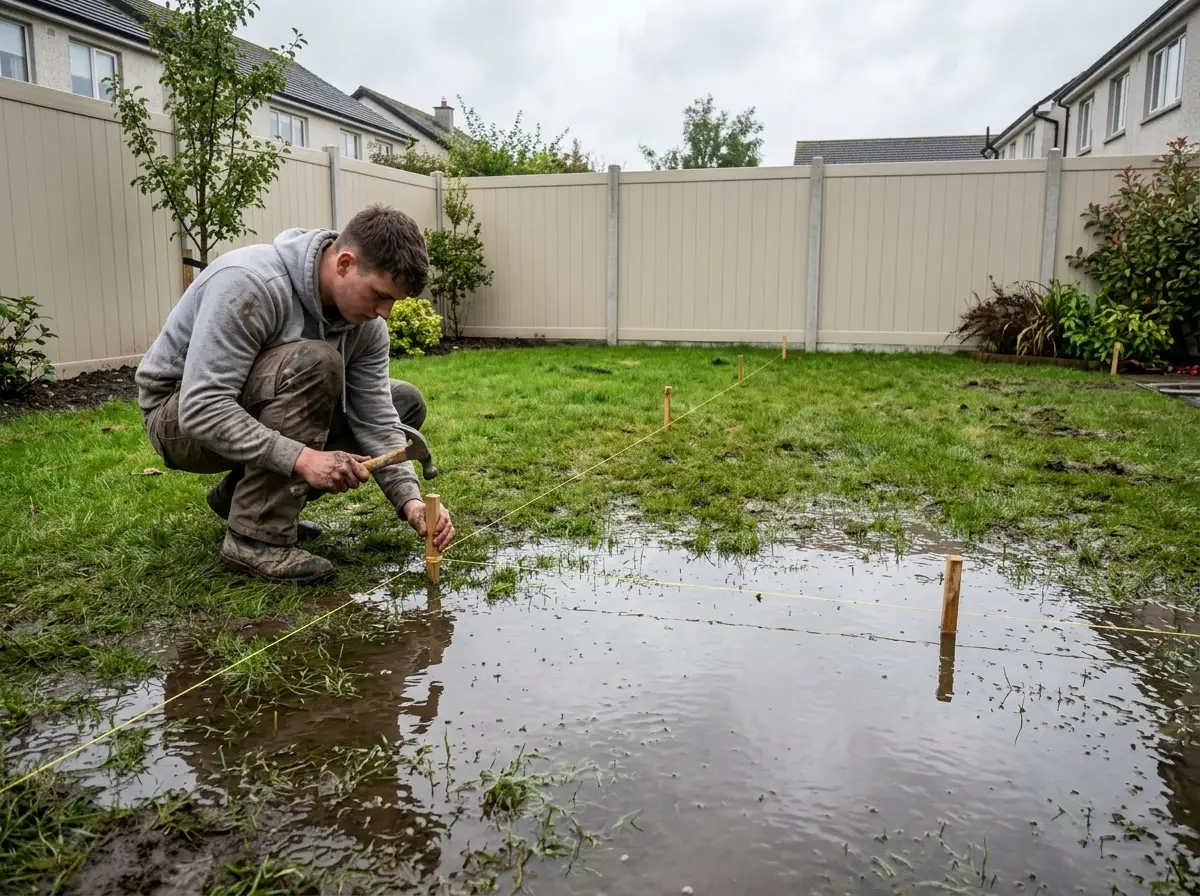
Water standing on a lawn either has nowhere lower to go, cannot soak into the ground it is sitting on, or is arriving faster than both.
Fall, soil, or compaction — which one is yours?
Do this before you price anything. Find the lowest point of the wet area and find the lowest point you are allowed to send water to. If the second is lower than the first, you have fall, and a pipe is the cheap answer. If it is not, no drain will run and the answer is a dry well, a pump, or regrading.
Next, test the soil. Dig a hole 12 inches deep and fill it with water. If it empties in under 4 hours the ground takes water and the problem is on the surface. If it still holds water the next day the ground does not, and a dry well will not work either, whatever anyone quotes.
Last, rule out compaction, because it is the most common wrong diagnosis on this page. Ground that has been driven on, parked on, or built over holds water on top while draining normally 12 inches down. Push a screwdriver in. If it stops in the first 3 inches, the ground is packed, and aerating or breaking the surface costs a fraction of a trench.
The jobs this covers, and what each one costs to get wrong
Yard Drainage
Surface collection — catch basins, shallow lines and grading — moving water off the lawn rather than out of the soil. It is the answer when water sits on top after rain. A subsurface drain does little for water that never soaks in.
What moves the price. How far the water has to travel to somewhere it may go, and what sits in between. Turf, a big tree, a drive, a fence with no gate. Putting the lawn back is a real line, and it is the one most quotes leave out.
When yard drainage is the wrong answer. Water standing on ground that already falls away is often packed hard rather than undrained. Opening the surface up costs a fraction of a trench. A lawn that has been parked on will tell you which one you have.
Grading and Swales
Reshaping ground so water leaves — a fall away from the wall, and a shallow channel to carry it. It is the answer that needs no pipe, and it is the one most often skipped. Where the ground falls toward the house, no drain compensates for long.
What moves the price. How much soil has to move, and where it comes from. Then putting back whatever grows on top. Where the fall has to be built up rather than cut away, brought-in soil is the line that moves the number.
When grading and swales is the wrong answer. If the ground already falls away and water still gets in, the problem is under the surface. No amount of reshaping reaches it. Grading is the first thing to check and the wrong thing to buy twice.
Dry Well Installation
A buried void — stone or a chamber — that holds water and lets it soak away over hours. It is the answer when there is nowhere to discharge to. It depends entirely on the surrounding soil accepting water, which is a fact about the site.
What moves the price. How big the void has to be. That is set by how much water arrives and how fast the ground takes it. A soak test comes first. Clay is what turns a small well into a large one, or rules it out.
When a dry well is the wrong answer. If there is anywhere lower to send water, a pipe to that point costs less. It also cannot silt up the way a buried chamber does. A dry well answers having nowhere to send water. It is not a preference.
Catch Basin Installation
A grated box at a low point, with a sump below the outlet that traps silt and leaves. It is the answer for a defined low spot that collects. It also makes a system serviceable, because the basin is where debris is meant to arrive.
What moves the price. How deep the outlet sits, how much pipe leaves the basin, and whether the grate has to take a car. A basin in a lawn and one in a drive are the same box with different lids. The prices are not close.
When a catch basin is the wrong answer. A dip that fills once a year after a freak storm rarely earns a basin and a buried run. Grading the dish out of the ground is often cheaper. It also leaves nothing to clean out later.
Curtain Drain Installation
A trench dug across a slope, above the thing it protects. It catches water in the soil before that water arrives. It is the answer when water comes from above rather than from below — a hillside, a neighboring lot, or a road shoulder draining toward the house.
What moves the price. How long the run is across the slope, and how deep it sits to catch water before it passes under. Rock, tree roots, and an outfall taken round the building are what turn one day into three.
When a curtain drain is the wrong answer. If the water comes off the roof, or rises through the ground the house sits on, a trench uphill catches none of it. Stand outside in real rain first. Do not pay to cut off a source that is not there.
Get an estimate in Syracuse
None of this can be priced from a description. Three things decide it. What the ground does with water. How much fall the site has. Where the water may go at the end. All three are facts about an address, and none of them show up in a photograph. Send the address and what you are seeing. Someone who does this work in Syracuse takes it from there. If it turns out to be a cheaper job than the one you came here for, that is worth hearing before anyone digs.
Syracuse Utah French Drain drainage services.
Read what a Syracuse drainage job costs before calling anyone, and check the Syracuse Utah French Drain service area to see whether your street is covered.
Back to Syracuse Utah French Drain.
The ground under Syracuse
Two yards on the same street can behave nothing alike
The fastest of the big soils here takes water at 4 inches an hour
This is the fastest of the largest soils mapped here, not a typical one, and the slowest sits in the same city — sometimes on the same street. That spread is why a neighbor's experience is a poor guide to your own yard, and why a soak test on your own ground beats any map.
USDA NRCS Soil Survey Geographic Database (SSURGO), via Soil Data Access
The group letter under your yard decides how much of a storm soaks in
The largest mapped soil is hydrologic group C
The USDA sorts soil into four groups by how fast water moves down through it. A takes water fastest, D holds it at the surface, and C is close to D. Rain that arrives faster than the ground takes it has to run somewhere, and where the grade does not carry it away it stands. Soil is mapped by the acre, so your own yard can differ.
USDA NRCS Soil Survey Geographic Database (SSURGO), via Soil Data Access
Questions people actually ask
What fall does a buried drain line need?
About 1 inch every 8 feet, which is a 1 percent grade. Less than that and silt settles instead of moving. Over a 60 foot run that is 7 to 8 inches of drop, and finding it is what decides whether a gravity drain is possible on a flat lot at all.
How do I know if a dry well will work here?
A soak test decides it and nothing else does. Fill a 12 inch hole and time it. Ground that takes 4 hours or less will accept a well; ground still holding water after 24 hours will not, and a well dug into it becomes a buried pond.
How deep should a swale be?
Usually 6 to 12 inches at the center, with sides shallow enough to mow — about 4 feet wide for every 6 inches of depth. Deeper is not better. A swale steep enough to scour is a swale that needs armoring, which costs more than making it wider.
Does a catch basin need cleaning?
Yes, and that is what the sump under the outlet is for. Once or twice a year in a lawn, more where leaves fall. A basin nobody opens for 5 years silts to the outlet and then the whole run behind it stops.
Where does a curtain drain go?
Uphill of the thing it protects, and deep enough to catch water moving through the soil rather than over it — usually 18 to 36 inches. Placed downhill it catches nothing, which is the most common way this job is done twice.
Trusted across Syracuse, Utah and Davis County
What this site is good for
-
Residential and commercial
A house with a wet basement and a site with standing water on a hardstanding are different jobs at different scales. Both are covered, and the pages say which is which.
-
Free, and nothing attached
Working out which job you actually have costs nothing and commits you to nothing. There is no fee to you at any point, because this site is paid by the contractor and not by you.
-
Your details are not for sale
An address sent here goes to a drainage contractor working in the area. It is never sold, and never passed to a second firm.
-
Permits named, not glossed
The pages name the authority that issues the permit for this work and the inspection that goes with it, so you can ask to see one before the first cut.
-
Every figure sourced and dated
Soil, rainfall and housing figures each name where they came from and when they were retrieved. Where a published estimate carries a margin of error, the margin is shown too.
-
One town, covered properly
This site is about one place and the towns within a short drive of it. It is not a national directory with a city name dropped into a template.
-
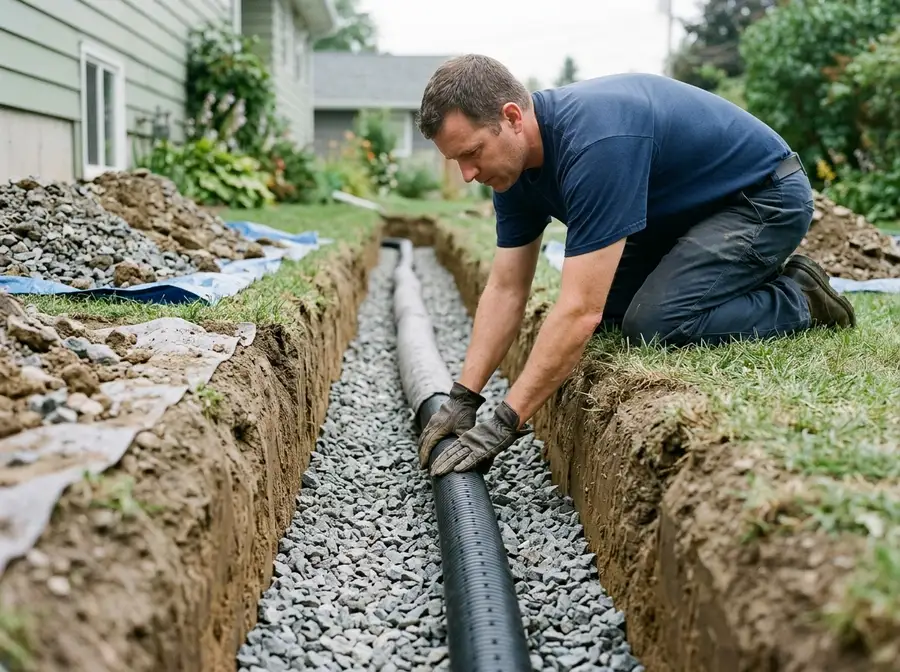
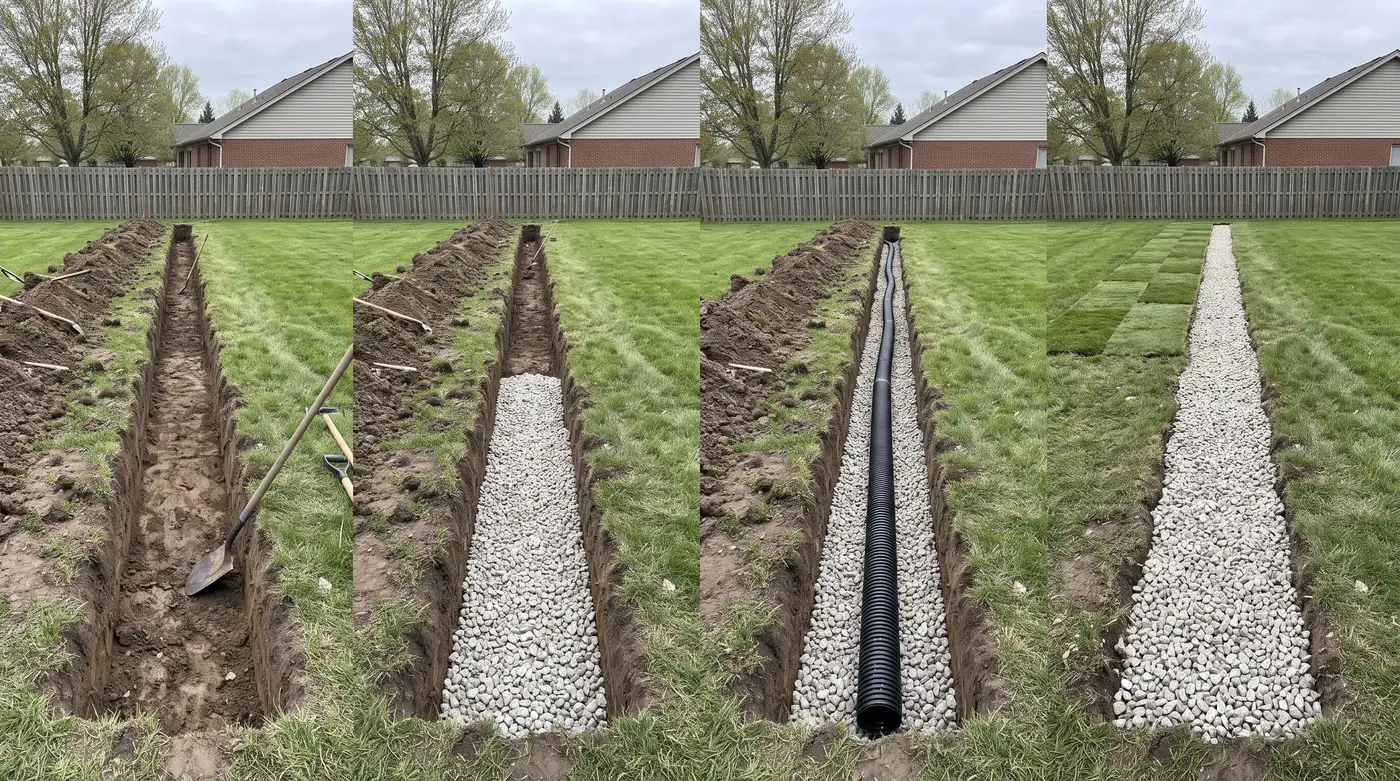
One run at four stages. The stone is the drain; the pipe is only how the water it collects gets out. -
Water standing at grade. Ground that sheds rather than takes is what puts it there.

Ground that is saturated has nowhere to put the next storm, and water sitting against a wall keeps working on it.
What happens after you send an address
-
The address first, and only then who you are
The first screen asks for the property address and checks that a contractor covers it. Only if one does does it ask for a name, a phone number and an email — there is no point taking your details to tell you nobody serves your street.
-
Your details are not for sale
It goes to a drainage contractor working in Syracuse. The details are never sold, and never passed to a second firm.
-
No cost, and nothing attached
There is no fee for sending an address and no obligation that follows from it. Deciding the work is the wrong work is a perfectly good outcome.
-
Who does the work
An independent drainage contractor, not the publisher of this site. Who runs this site, and where every figure on it comes from, is set out on the about page.